- 402-403, Saavan Square, New Ranip, Ahmedabad, Gujarat - 382470
- +91 63524 86473

Robotic Knee Replacement Surgeon in Shilaj: Advanced Knee Replacement Care by Dr. Ronak Patel
Persistent knee pain, stiffness, swelling, and difficulty walking can significantly affect daily life, particularly when advanced osteoarthritis has damaged the joint. For patients considering advanced surgical treatment, consulting an experienced Robotic Knee Replacement Surgeon in Shilaj can help them understand whether robotic-assisted knee replacement is appropriate for their condition. Dr. Ronak Patel, DNB Orthopedic, FIAS (Fellowship in Joint Replacement), and MNAMS, specializes in knee and hip replacement procedures and provides advanced robotic knee replacement care at Synergy Hospital, Ahmedabad.
What Is Robotic Knee Replacement?
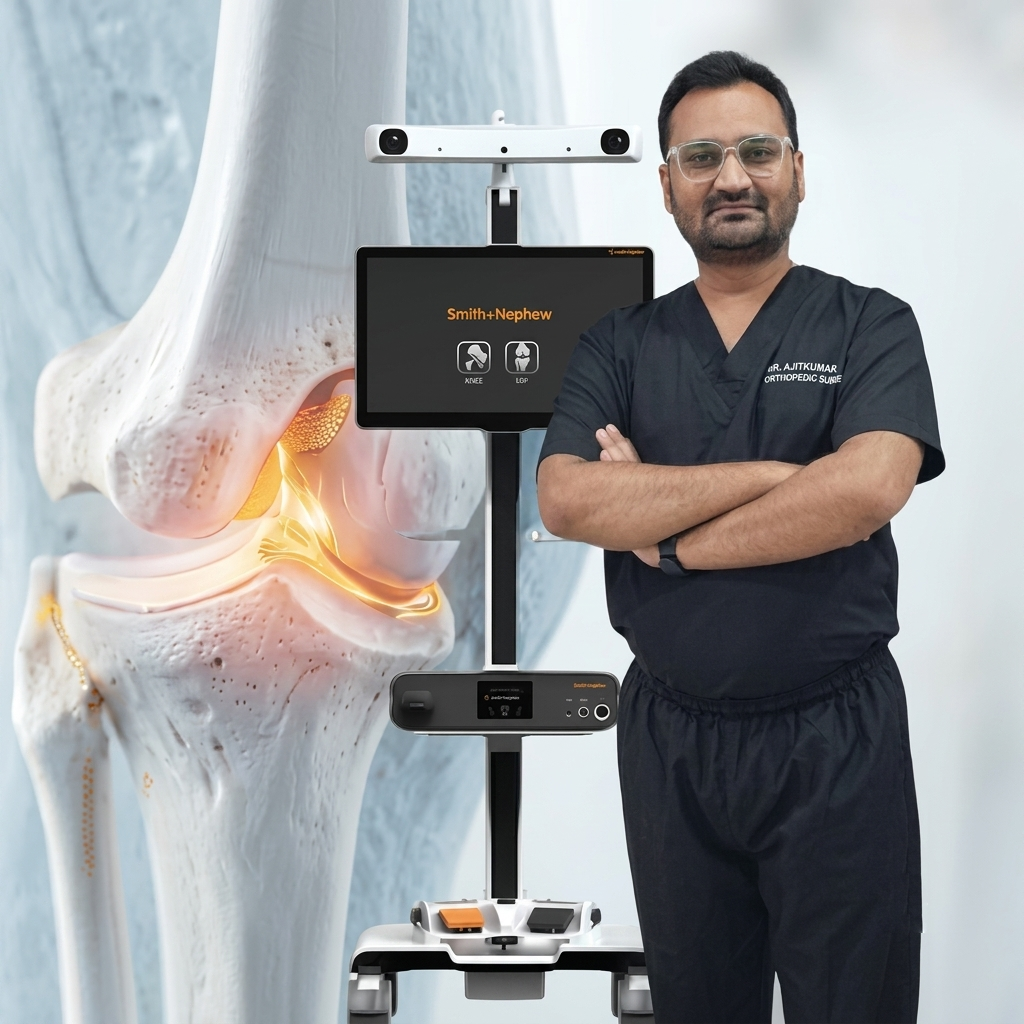
Robotic knee replacement is an advanced surgical technique in which a robotic-assisted system helps the orthopedic surgeon plan and execute precise bone preparation and implant positioning. The technology does not replace the surgeon. Instead, it provides detailed anatomical information and surgical guidance while the surgeon remains in control of the procedure.
For suitable patients, Robotic-Assisted Knee Replacement in Shilaj can involve three-dimensional planning of the knee anatomy, assessment of alignment, and evaluation of ligament balance. According to Dr. Ronak Patel's treatment information, robotic mapping can help create a personalized surgical plan and assist with implant positioning with sub-millimetre precision.
Why Consider Robotic Knee Surgery?
Severe osteoarthritis can cause cartilage loss, bone-on-bone contact, deformity, and progressive loss of mobility. When non-surgical treatments no longer provide adequate relief, knee replacement may be considered.
Robotic Knee Surgery in Shilaj uses digital planning and robotic assistance to support accurate bone preparation and implant alignment. Potential advantages may include:
- Detailed 3D pre-operative planning
- More precise implant positioning
- Personalized alignment based on knee anatomy
- Controlled bone preparation
- Soft-tissue balancing during surgery
- Support for early mobilization and rehabilitation
The suitability of robotic surgery depends on the patient's diagnosis, joint condition, bone quality, deformity, medical history, and overall health. A consultation is therefore essential before deciding on surgery.
Meet Dr. Ronak Patel
Dr. Ronak Patel is a joint replacement surgeon with qualifications including DNB Orthopedic, FIAS in Joint Replacement, and MNAMS. His practice focuses on knee and hip replacement, arthroscopy, complex reconstruction, and revision joint replacement procedures. His website states that he has more than 10 years of orthopedic surgical experience.
Patients looking for a Robotic Knee Replacement Specialist in Shilaj can discuss their symptoms, imaging results, treatment history, and surgical options with Dr. Ronak Patel. His approach includes evaluating the individual condition before recommending an appropriate treatment pathway.
How Robotic Knee Replacement Works
The process generally begins with a detailed orthopedic assessment and appropriate imaging. A three-dimensional representation of the knee can then be used to develop a surgical roadmap.
During surgery, robotic assistance helps the surgeon execute the planned bone cuts and implant positioning with high precision. The surgeon continuously controls the procedure and makes clinical decisions based on the patient's anatomy and intraoperative findings.
At Synergy Hospital, the published procedure includes five broad stages:
- Pre-operative evaluation and scanning – Assessment and 3D modeling of knee anatomy.
- Robotic surgical planning – Planning implant size, depth, angle, and alignment.
- Robotic-assisted execution – Guided bone preparation and implant positioning.
- Balancing and fixation – Assessment of knee movement and soft-tissue balance.
- Rehabilitation – Early movement and physiotherapy under clinical supervision.
Who May Need Robotic Knee Replacement?
A Robotic Knee Replacement Doctor in Shilaj may evaluate patients experiencing advanced arthritis, persistent knee pain, reduced walking ability, stiffness, deformity, or difficulty performing everyday activities despite conservative treatment.
Common symptoms that warrant an orthopedic evaluation include:
- Persistent knee pain while walking or resting
- Difficulty climbing stairs
- Reduced knee movement
- Recurrent swelling or stiffness
- Difficulty standing for prolonged periods
- Bow-legged or knock-kneed deformity
- Reduced quality of life because of knee pain
Not every patient requires robotic replacement. Depending on the extent and location of cartilage damage, alternatives may include medication, physiotherapy, injections, arthroscopy, partial knee replacement, or other treatment options.
Choosing a Knee Replacement Hospital Near Shilaj
When searching for a Robotic Knee Replacement Hospital in Shilaj, patients should consider more than technology alone. Important factors include surgeon experience, operation-theatre standards, implant options, anesthesia support, infection-control protocols, diagnostic facilities, and post-operative rehabilitation.
Synergy Hospital, New Ranip, provides orthopedic surgical care under Dr. Ronak Patel and has facilities for knee and hip replacement procedures, physiotherapy, rehabilitation, and follow-up care. The hospital's published information also describes modern operation-theatre infrastructure and personalized recovery support.
Recovery After Robotic Knee Replacement
Recovery differs between patients and depends on age, physical condition, severity of arthritis, surgical complexity, rehabilitation participation, and other medical factors. The treatment information published by Dr. Ronak Patel indicates that many patients can begin walking with support within approximately 24–48 hours, while rehabilitation continues progressively afterward.
Physiotherapy is an important part of recovery. Exercises typically focus on improving knee movement, strengthening the surrounding muscles, restoring walking ability, and gradually returning to daily activities.
Patients should follow their surgeon's individualized rehabilitation plan rather than comparing their recovery timeline with another patient's experience.
Why Consult Dr. Ronak Patel?
For patients researching the Best Robotic Knee Replacement Surgeon in Shilaj, it is important to assess qualifications, specialization, surgical experience, treatment approach, hospital facilities, and post-operative support.
Dr. Ronak Patel's qualifications include DNB Orthopedic, FIAS in Joint Replacement, and MNAMS. He specializes in knee and hip arthroplasty, including robotic knee replacement, total knee replacement, revision procedures, and other orthopedic treatments.
Patients searching for a Knee Replacement Surgeon Near Shilaj, a Knee Replacement Doctor in Shilaj, or a Best Knee Replacement Doctor in Shilaj can consult Dr. Ronak Patel for an individualized evaluation and treatment discussion.
Frequently Asked Questions
1. What does a robotic knee replacement surgeon do?
A Robotic Knee Replacement Surgeon in Shilaj uses robotic-assisted technology to support surgical planning, bone preparation, alignment, and implant positioning while personally controlling the procedure.
2. Is robotic knee replacement better than conventional knee replacement?
Robotic assistance can provide detailed 3D planning and support precise implant positioning, but the appropriate technique depends on the patient's anatomy and clinical condition. Your orthopedic surgeon can explain which approach is suitable for you.
3. How long does recovery take after robotic knee surgery?
Recovery varies from patient to patient. Many patients may begin walking with support within 24–48 hours, while complete rehabilitation takes longer and depends on physiotherapy, healing, and individual health factors.
4. Where can I consult for robotic knee replacement near Shilaj?
Patients searching for a Robotic Knee Replacement Surgeon in Shilaj can consult Dr. Ronak Patel at Synergy Hospital, New Ranip, Ahmedabad.
Take the Next Step Toward Better Knee Mobility
Advanced robotic technology can support personalized planning and precise execution of knee replacement surgery, but successful treatment also depends on appropriate patient selection, surgical expertise, rehabilitation, and follow-up care. If persistent knee pain is affecting your mobility or everyday activities, consulting Dr. Ronak Patel can help you understand whether robotic knee replacement is appropriate for your condition.
For patients seeking a Robotic Knee Replacement Surgeon in Shilaj, Dr. Ronak Patel provides specialized knee and joint replacement consultation at Synergy Hospital, Ahmedabad, with a focus on precision-based surgery, personalized treatment planning, and structured rehabilitation.
Tags: Robotic Knee Replacement Surgeon in Shilaj, Best Robotic Knee Replacement Surgeon in Shilaj, Robotic Knee Replacement Doctor in Shilaj, Robotic Knee Surgery in Shilaj, Robotic Knee Replacement Hospital in Shilaj, Robotic-Assisted Knee Replacement in Shilaj, Robotic Knee Replacement Specialist in Shilaj, Knee Replacement Surgeon Near Shilaj, Knee Replacement Doctor in Shilaj, Best Knee Replacement Doctor in Shilaj, Joint Replacement Surgeon in Shilaj, Orthopedic Surgeon in Shilaj, Knee Surgeon in Shilaj, Total Knee Replacement Surgeon in Shilaj, Advanced Knee Replacement Surgeon in Shilaj, Minimally Invasive Knee Replacement in Shilaj, Robotic Joint Replacement in Shilaj, Robotic Orthopedic Surgeon in Shilaj, Knee Arthritis Treatment in Shilaj, Knee Pain Treatment in Shilaj, Knee Replacement Surgery in Shilaj, Knee Replacement Hospital Near Shilaj.