

Choosing a knee replacement surgeon is one of the most important healthcare decisions you will ever make. The artificial joint placed in your knee today needs to perform well — and without problems — for the next 15 to 20 years. That means your surgeon’s experience, technique, and the hospital they operate in all matter just as much as the surgery itself.
In Ahmedabad, several orthopaedic surgeons offer knee replacement surgery. How do you know who to trust? This guide gives you eight practical questions to ask at your first consultation — and explains what a good answer looks and sounds like.

I am sharing these questions because every patient deserves to make a confident, informed choice. These are the same criteria I would use if I were selecting a surgeon for my own family member — whoever you ultimately choose.
Q 1 How Many Knee Replacements Have You Performed?
Surgical volume is one of the strongest predictors of a good outcome. A surgeon who performs a high number of knee replacements regularly has developed refined technique, the ability to manage unexpected findings calmly, and consistent results across many different patient types.
When you ask this question, you are not just looking for a lifetime total — you want to understand whether this surgeon performs knee replacement as core, daily work or occasionally alongside many other procedures. There is a significant difference in feel and judgement between the two.
Dr. Ronak Patel has performed over 6,000 joint replacement surgeries at Synergy Hospital, New Ranip, Ahmedabad.
Q 2 Are You Fellowship-Trained in Joint Replacement?
An MS (Orthopaedics) qualification covers a wide range of bone and joint conditions — fractures, sports injuries, spine problems, and more. A fellowship in joint arthroplasty is additional specialised training focused exclusively on knee and hip replacement surgery, typically completed at a high-volume centre.
This matters because the techniques, implant choices, and complications in joint replacement are highly specific. Fellowship-trained surgeons have seen a much larger and more varied caseload during training, which translates directly to better surgical judgement when it counts.
Ask where the fellowship was completed and how many replacement surgeries were performed during that training period.
Q 3 Do You Perform Robotic Knee Replacement?
Not every surgeon in Ahmedabad has access to robotic-assisted surgery — and not every patient necessarily needs it. But it is worth asking. Robotic knee replacement creates a personalised 3D model of your specific knee before surgery, which guides the implant placement to within sub-millimetre accuracy. For most patients under 70, this translates to better long-term outcomes and faster recovery.
If robotic surgery is not appropriate for your situation — due to cost, medical reasons, or the nature of your case — a good surgeon will explain that honestly. The point of asking is simply to understand what is available and whether the surgeon can give you an objective, personalised recommendation.
Dr. Ronak Patel has been performing robotic knee replacement surgery at Synergy Hospital, New Ranip, and has built one of the largest robotic joint replacement practices in Gujarat. For a side-by-side comparison of both approaches, read our guide on robotic vs traditional knee replacement.
Q 4 What Implant Brands Do You Use — and Why?
The artificial joint placed in your knee — called the implant — is what your new knee is made of. It will be inside your body for 15 to 25 years, so the choice of implant deserves a clear, specific answer during your consultation.
Different implant brands — Stryker, Zimmer Biomet, DePuy Synthes — have different designs, material compositions, and track records. The right implant for you depends on your anatomy, body weight, activity level, and the specific pattern of arthritis in your knee.
A surgeon who explains why they are recommending a particular implant for your case — not just “this is what we use” — is a surgeon who takes their outcomes seriously. Ask whether the implant will be appropriately sized for your knee anatomy.
Q 5 What Hospital Will the Surgery Be Performed At?
Even the most skilled surgeon cannot deliver the best outcome in a poorly equipped setting. The hospital matters — particularly the operation theatre, infection control protocols, post-operative nursing, in-house physiotherapy, and emergency response capability.
Key things to look for at the hospital:
- Modular operation theatre with laminar air flow (this significantly reduces infection risk)
- Digital X-ray and diagnostic imaging available on-site
- Dedicated in-house physiotherapy team for post-operative rehabilitation
- 24-hour nursing care and emergency support
- Cashless insurance facility with your specific provider
Synergy Hospital, New Ranip, Ahmedabad provides all of the above. You can learn more about the orthopaedic facilities here.
Q 6 What Is Your Complication Rate and How Do You Handle Complications?
Every surgical procedure carries some element of risk. The right question is not “can complications happen?” — they can with any surgery. The question to ask is: how does this surgeon respond when they do?
An experienced surgeon will speak clearly about the steps they take to minimise risk from the beginning — pre-operative health optimisation, antibiotic protocols, anti-clotting measures, and early mobilisation after surgery. They will also have clear processes for managing the most common post-operative concerns.
If a surgeon is evasive or gives vague answers when you raise this topic, that is worth noting. Transparency about risk is the mark of a surgeon who takes their responsibility to patients seriously.
Q 7 Is Cashless Insurance Available at Your Hospital?
Managing insurance paperwork while recovering from major surgery is a real burden — both for patients and for family members managing the process. A hospital with a dedicated cashless insurance settlement facility handles pre-authorisation and direct billing with your insurer, so your energy can go entirely towards recovery.
Ask whether your specific insurance company is empanelled with the hospital — not just whether cashless insurance is available in general. Synergy Hospital accepts cashless claims from 18+ providers including Ayushman Bharat, CGHS, ECHS, and all major private health insurers.
Q 8 What Does Post-Operative Care and Follow-Up Look Like?
Surgery is only the first step. The physiotherapy, wound care, follow-up appointments, and monitoring in the weeks after your operation determine how well your knee ultimately performs. A surgeon who is hard to reach after discharge — or who transfers you entirely to a junior team — is not providing complete care.
Before you commit, ask:
- When does physiotherapy begin after surgery?
- What are the scheduled follow-up appointments — at 2 weeks, 6 weeks, 3 months?
- Who do I contact with concerns after going home?
- What warning signs should prompt me to come back in?
At Synergy Hospital, physiotherapy begins within 24 hours of surgery. Dr. Ronak Patel personally conducts follow-up reviews at all key post-operative milestones and provides a direct contact number for urgent queries after discharge.

Why Patients in Ahmedabad Choose Dr. Ronak Patel
Based at Synergy Hospital, 402-403 Saavan Square, New Ranip, Ahmedabad — view full profile
- 6,000+ joint replacement surgeries performed
- Fellowship-trained in joint arthroplasty and arthroscopy
- One of the largest robotic joint replacement practices in Gujarat
- Globally trusted implant brands — selected for each patient’s anatomy
- Modular operation theatre with laminar air flow at Synergy Hospital
- Cashless insurance with 18+ providers including CGHS & ECHS
- Physiotherapy begins within 24 hours of surgery
- Personal follow-up care at every milestone — not outsourced to junior staff
The right knee replacement surgeon is fellowship-trained, performs this surgery at high volume, operates in a well-equipped hospital, communicates openly about risks and implant choices, and stays personally involved in your care after discharge. These eight questions will quickly show you who is serious about their outcomes — and who is not.
Ready to Consult Dr. Ronak Patel?
Bring your X-rays and your questions. Get an honest assessment, a personalised surgical plan, and full insurance guidance — all in one appointment.
+91 63524 86473 Book Appointment OnlineFrequently Asked Questions
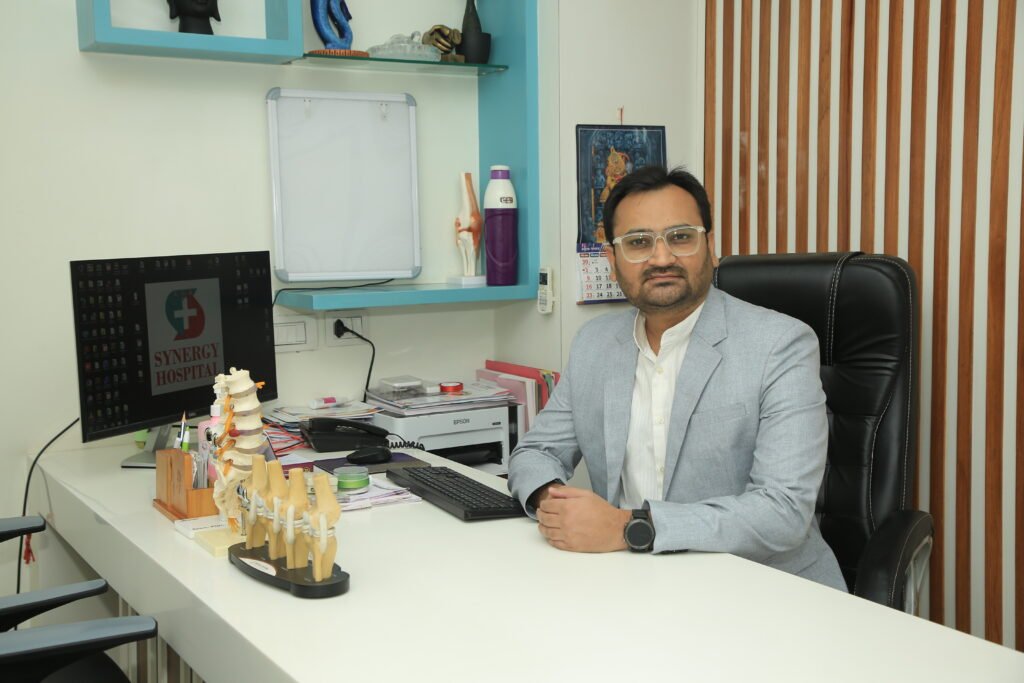
Dr. Ronak Patel
Why Choose Us?
- Cashless with 18+ insurance providers
- CGHS / ECHS accepted
- On-site physiotherapy & rehabilitation
- 24/7 emergency & ambulance service
- Digital X-ray & diagnostics in-house
- 24/7 pharmacy & round-the-clock staff
- Modular operation theatres
Related Articles