

Knee pain can start as a mild discomfort and slowly become something that controls your entire life — limiting how far you walk, how well you sleep, and whether you can climb stairs without holding the railing. Most people try to manage with pain medication, physiotherapy, and injections for years before finally seeking surgical help.
But here is the honest truth: waiting too long can make surgery more difficult and recovery slower. Knowing when it is time to take the next step can save you years of unnecessary pain.
As a joint replacement surgeon who has performed over 6,000 knee surgeries in Ahmedabad, I have seen every stage of knee degeneration. In this article, I will walk you through the 7 clear signs that your knee is telling you it needs replacement — not just rest.
This article is for guidance only. Only a qualified orthopaedic surgeon can assess whether knee replacement surgery is right for you — after a physical examination and X-ray. If you are experiencing any of these signs, book a consultation at Synergy Hospital, New Ranip, Ahmedabad. Call: +91 63524 86473
Sign #1: Severe Pain That Doesn’t Respond to Medication

Pain that rules your day — and your night
If your knee pain used to come and go but now it is constant — present even when you are sitting or lying down — this is a significant warning sign. Healthy joints do not hurt at rest. Pain at rest means the cartilage that protects your knee joint has worn away significantly, and the bones are grinding against each other.
When painkillers like paracetamol, ibuprofen, or even prescription medications no longer give you relief for more than a few hours, it means the damage is beyond what medication can manage. At this stage, knee replacement surgery is the medically appropriate next step.
Sign #2: Your Knee Swells Regularly — Even With Light Activity

Swelling that keeps coming back
Swelling after activity is normal in a mildly arthritic knee. But if your knee swells up after light walking, cooking, or climbing a few stairs — and takes 2–3 days to settle — the joint is chronically inflamed.
Repeated swelling means the joint is reacting to bone-on-bone friction and releasing excess fluid. Steroid injections may have helped initially, but their effect reduces with each repeat injection. When injections stop working, surgery is the next logical step. Our cashless insurance facility means most patients pay nothing out of pocket.
Sign #3: You Are Limping or Changing Your Gait to Avoid Pain

You walk differently than you used to
When your knee hurts, your body naturally adjusts the way you walk to protect it. You might shift weight to the other leg, avoid bending the knee fully, or develop a visible limp. This protective posture might reduce knee pain short-term, but it causes new problems in your hip, lower back, and the opposite knee.
If people around you have commented on your walk, or if you find yourself planning routes to avoid stairs or uneven surfaces, your knee is already affecting your quality of life. Both total knee replacement and robotic knee replacement restore normal gait within weeks of surgery.
Sign #4: Your Knee Is Stiff — Especially in the Morning

Morning stiffness lasting more than 30 minutes
It is normal to feel slightly stiff after sleeping. But if your knee takes more than 30 minutes to loosen up every morning, or if it seizes up after sitting for a short time (like watching a film or travelling by car), this is a sign of significant joint damage.
Stiffness happens because the cartilage has thinned and the joint space has narrowed. The joint needs movement to lubricate itself — but when cartilage is gone, movement itself becomes painful. An X-ray at Synergy Hospital will confirm the extent of damage.
Sign #5: Your Knee Looks Deformed or Has Bowed Inward/Outward

Visible deformity in the knee
If you look at your legs from the front and your knees appear to bow inward (knock-knee) or outward (bow-legged) when they did not before, the joint has collapsed on one side due to severe cartilage loss.
This kind of deformity does not correct itself with exercise or physiotherapy. Robotic knee replacement surgery is particularly effective for deformed knees — the robotic system corrects alignment with sub-millimetre precision. Dr. Ronak Patel performed Ahmedabad’s first-ever robotic knee replacement and routinely corrects severe deformities.
Sign #6: You Have Given Up Activities You Love Because of Your Knee

Your knee has stolen your independence
This is perhaps the most important sign. When you stop going to family events because you cannot manage the walking. When you give up your morning walk, your travel plans, or even shopping trips. When you depend on others to help you with daily activities. This is your knee controlling your life.
Surgery is not just about eliminating pain. It is about restoring the freedom to live the way you want. Most patients at Dr. Ronak Patel’s clinic in New Ranip, Ahmedabad say the biggest change after surgery is getting their independence back — not just pain relief.
Sign #7: Non-Surgical Treatments Are No Longer Helping

You have tried everything — and nothing is working
Before surgery, most patients have already tried:
- Physiotherapy and strengthening exercises
- Anti-inflammatory medications
- Corticosteroid (steroid) injections
- Hyaluronic acid (gel) injections
- Weight loss and dietary changes
- Walking aids — stick, walker, knee brace
If you have exhausted these options and your knee pain and function have not improved — or have continued to get worse — then surgery is the medically appropriate next step. Continuing to delay will only allow the joint damage to progress further, making surgery more complex and costly.
When Is It Too Early — Or Too Late — for Knee Replacement?

Too early: If you are in your 40s and have mild-to-moderate arthritis that still responds to physiotherapy and injections, surgery can wait. We explore partial knee replacement (Microplasty) as a bone-preserving option that replaces only the damaged compartment — shorter recovery, same results.
Too late: There is no age limit for knee replacement. Patients in their 80s routinely undergo successful surgery at Synergy Hospital, New Ranip. However, severe deformity and muscle weakness from prolonged delay can make recovery harder. The best time to act is when non-surgical options have clearly stopped working.
You are falling due to knee instability, you have stopped sleeping properly due to knee pain, or you cannot perform basic daily activities like bathing, cooking, or getting in and out of a car. These are signs that surgery should not be delayed further. Call us: +91 63524 86473.
What Happens at Your First Consultation in Ahmedabad?
Your first appointment with Dr. Ronak Patel at Synergy Hospital, New Ranip, Ahmedabad typically takes 30–45 minutes and includes:
- Medical history — how long you have had pain, what you have tried, current medications and health conditions
- Physical examination — range of motion, strength, deformity, gait assessment
- X-ray review — to assess the degree of cartilage loss and joint space narrowing at our advanced diagnostic facility
- Surgical recommendation — total knee replacement, partial knee (Microplasty), or continued non-surgical management
- Full cost and insurance guidance — cashless insurance available with CGHS, ECHS, Star Health, ICICI Lombard, HDFC ERGO and all major providers
There is no obligation. The goal is to give you complete clarity on where you stand and what your options are.
Patients visit Dr. Ronak Patel at Synergy Hospital from across Ahmedabad — New Ranip, Chandkheda, Sabarmati, Gota, Motera, Ranip, Ognaj, Vadaj and beyond. Find your nearest location page or call us to book.
Think It Might Be Time? Let’s Find Out Together.
Get an honest assessment from Dr. Ronak Patel at Synergy Hospital, New Ranip, Ahmedabad — no pressure, just clarity on your next step.
Call: +91 63524 86473 Book OnlineFrequently Asked Questions
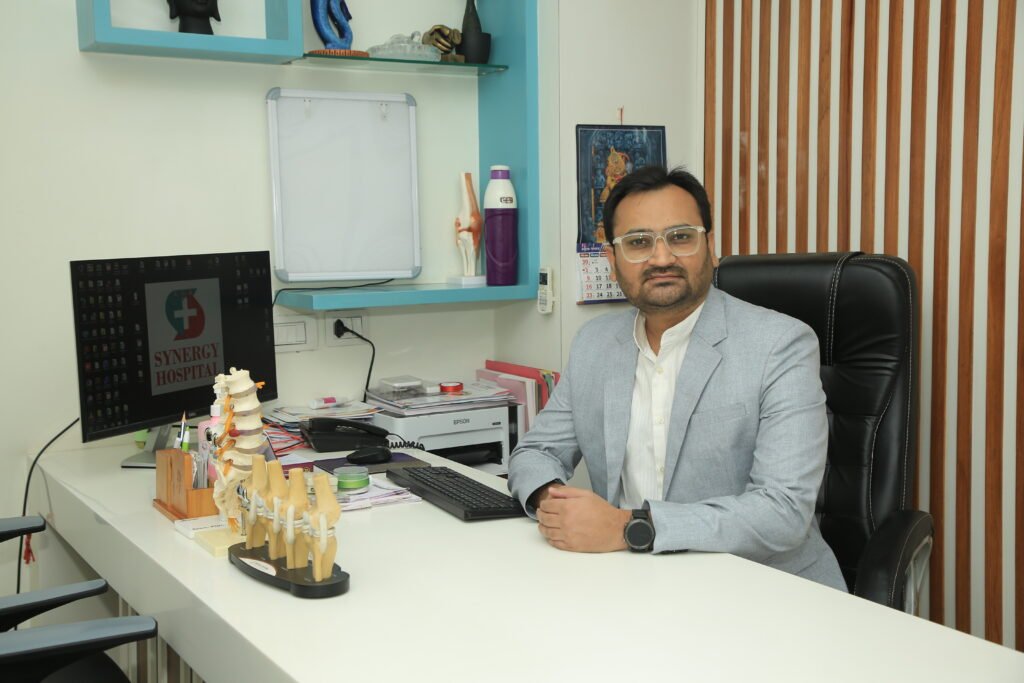
Dr. Ronak Patel
Why Choose Us?
- Cashless with 18+ insurance providers
- CGHS / ECHS accepted
- On-site physiotherapy & rehabilitation
- 24/7 emergency & ambulance service
- Digital X-ray & diagnostics in-house
- 24/7 pharmacy & round-the-clock staff
- Modular operation theatres
Related Articles